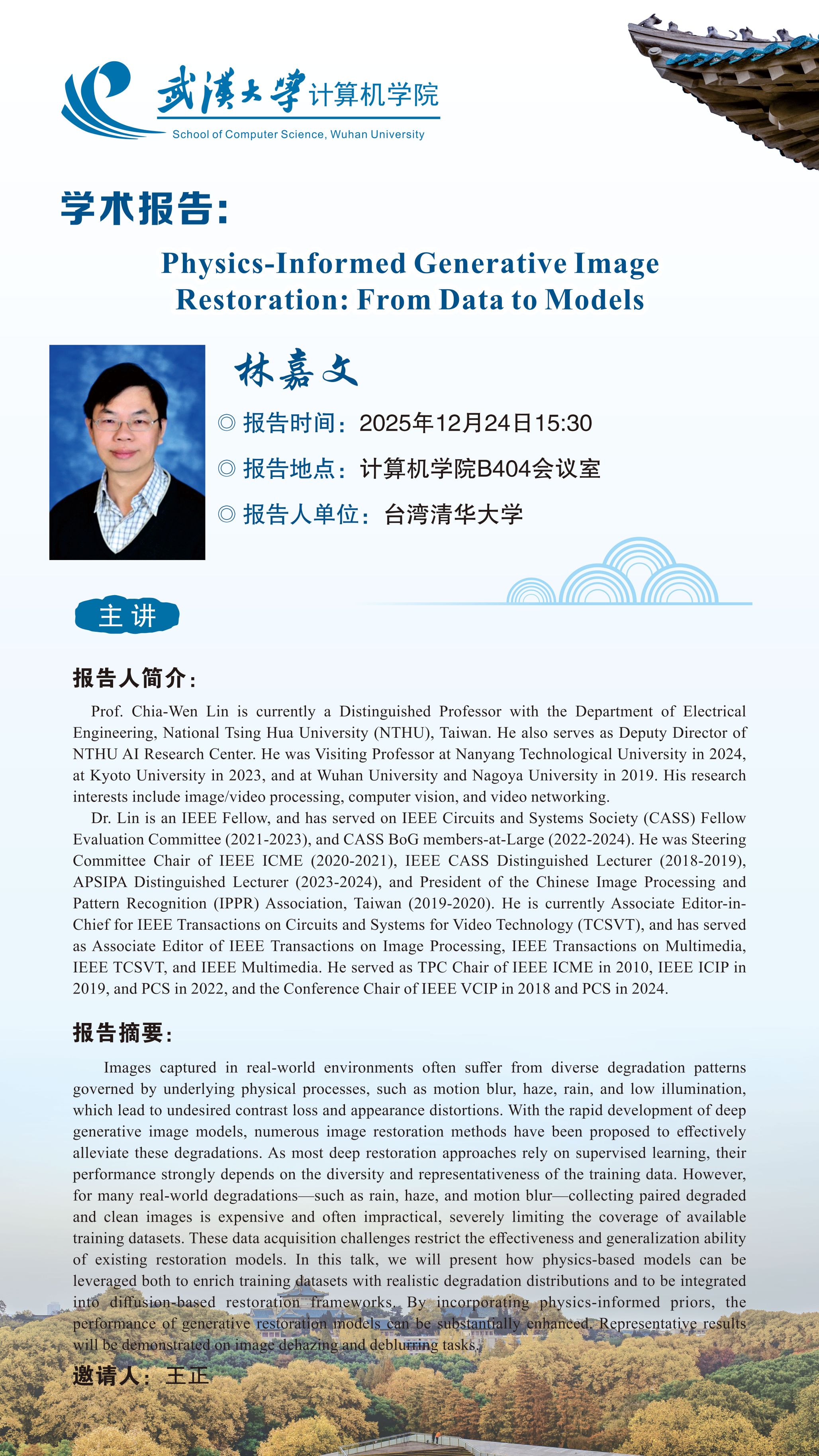
报告题目:Physics-Informed Generative Image Restoration: From Data to Models
报告时间:2025年12月24日15:30
报告地点:85porn
B404会议室
报告人:林嘉文
报告人单位:台湾清华大学
报告人简介:Prof. Chia-Wen Lin is currently a Distinguished Professor with the Department of Electrical Engineering, National Tsing Hua University (NTHU), Taiwan. He also serves as Deputy Director of NTHU AI Research Center. He was Visiting Professor at Nanyang Technological University in 2024, at Kyoto University in 2023, and at Wuhan University and Nagoya University in 2019. His research interests include image/video processing, computer vision, and video networking.
Dr. Lin is an IEEE Fellow, and has served on IEEE Circuits and Systems Society (CASS) Fellow Evaluation Committee (2021‐2023), and CASS BoG members-at-Large (2022‐2024). He was Steering Committee Chair of IEEE ICME (2020‐2021), IEEE CASS Distinguished Lecturer (2018‐2019), APSIPA Distinguished Lecturer (2023‐2024), and President of the Chinese Image Processing and Pattern Recognition (IPPR) Association, Taiwan (2019‐2020). He is currently Associate Editor-in-Chief for IEEE Transactions on Circuits and Systems for Video Technology (TCSVT), and has served as Associate Editor of IEEE Transactions on Image Processing, IEEE Transactions on Multimedia, IEEE TCSVT, and IEEE Multimedia. He served as TPC Chair of IEEE ICME in 2010, IEEE ICIP in 2019, and PCS in 2022, and the Conference Chair of IEEE VCIP in 2018 and PCS in 2024.
报告摘要:Images captured in real-world environments often suffer from diverse degradation patterns governed by underlying physical processes, such as motion blur, haze, rain, and low illumination, which lead to undesired contrast loss and appearance distortions. With the rapid development of deep generative image models, numerous image restoration methods have been proposed to effectively alleviate these degradations. As most deep restoration approaches rely on supervised learning, their performance strongly depends on the diversity and representativeness of the training data. However, for many real-world degradations—such as rain, haze, and motion blur—collecting paired degraded and clean images is expensive and often impractical, severely limiting the coverage of available training datasets. These data acquisition challenges restrict the effectiveness and generalization ability of existing restoration models. In this talk, we will present how physics-based models can be leveraged both to enrich training datasets with realistic degradation distributions and to be integrated into diffusion-based restoration frameworks. By incorporating physics-informed priors, the performance of generative restoration models can be substantially enhanced. Representative results will be demonstrated on image dehazing and deblurring tasks.
邀请人:王正